
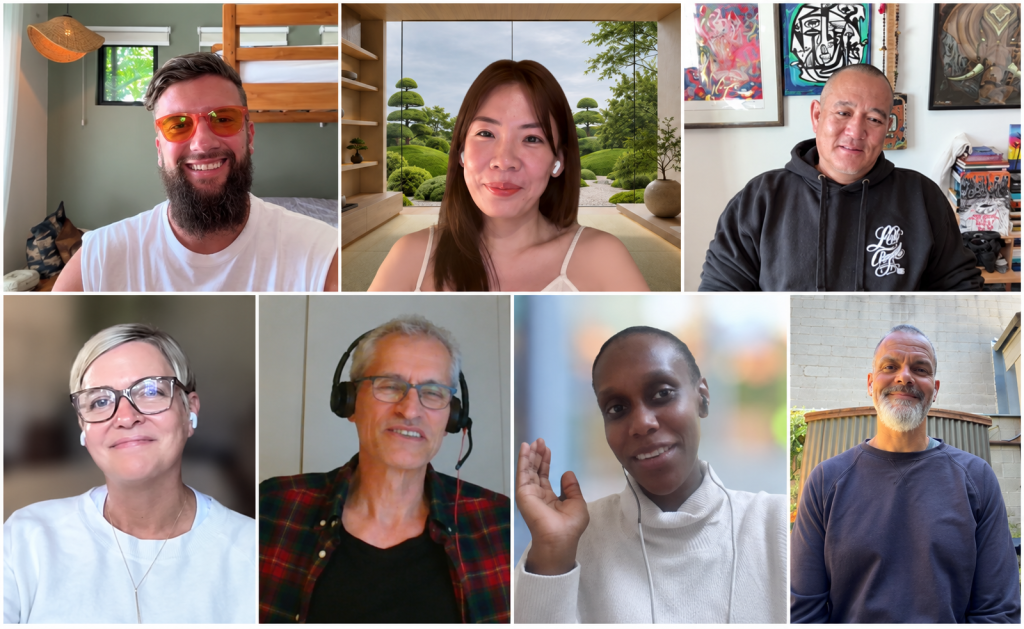
The occasion was a close-knit Heart Circle of friends and near-strangers, and that day we were invited to name what was dying in our lives and what was being born. Two persons shared before me, and while they spoke I had leisure enough, and composure enough, to rehearse my answer, as one rehearses a story told so often that it no longer cuts on the way out.
Until that season of my life, I had known cruelty only by report, as a thing that befell other women in other houses. I met it at last, and I met it entire: the blows, the artful management of my mind, the slow and studied torment from a man who knew precisely where I was soft. What died, I said, was my naïveté, and with it my rainbow-coloured opinion of what human beings might be. Here my voice, which had conducted itself admirably until that moment, broke upon the word.
I recovered myself sufficiently to deliver the second part, the easy part, the rebirth. I had torn myself away from my abuser, and the leaving was like wrenching free of a drowning man who drags his rescuer down. Released at last, I said that I can now lie upon my pillow at night and sleep without dread: of being attacked, of being made to doubt my own mind, of being schemed against, of being watched as a hare is watched by the hound. A new lease on life, a rebirth, I called it, yet the words did nothing to hold me up. I wept on Zoom, before a screen of friends in the Heart Circle, who had done nothing to deserve it but listen.
I’ve told this story before. That’s what unsettled me. The facts hadn’t changed, and neither had the ending: I have put that abuse behind me, and I am now safe. Why, then, should a sentence I had spoken so often turn upon me and split me open?
Ronnie Janoff-Bulman spent years studying what trauma does to the mind, and her answer is the one I keep returning to. She called it the shattering of our assumptive world. Most of us walk around on three unspoken beliefs: (1) the world is mostly benevolent, (2) life makes sense, and (3) I am a person worthy of safety. Nobody chooses these. They’re laid down in childhood, quietly, and they work like a floor. You don’t think about a floor until it gives way.
The phrase assumptive world belongs to the grief researcher Colin Murray Parkes. Janoff-Bulman carried it into trauma, working from survivors of violence, accident and illness, and found that what breaks in them isn’t only their sense of safety. It’s the framework that produced it. A leading view in neuroscience is of the brain as a prediction engine, forever forecasting what comes next from stored models of how things and people behave. Those three beliefs are the deepest models it holds, the ones every other forecast stands on. When they fail, no opinion has changed. Instead, every prediction built on them has to be rebuilt.
Abuse at the hands of a partner dismantles all three models at once. The person who pummelled me by degrees and and silenced me year after year, wasn’t a stranger in a car park. I knew him. I knew his kin, his habits. I had every reason to believe I knew him . Jennifer Freyd calls this betrayal trauma: the injury lands hardest when the harm comes from someone you depended on. Fear is only part of it. The deeper wound is what I had used to read people: my instincts, my generosity, my willingness to believe the best. All of it was handed to the one person who turned it into a way in.
Freyd’s theory began with a clinical puzzle: why do people harmed by a partner so often seem not to register what happened? Her answer was that the mind sometimes walls the information off. When the person hurting you is also the person you depend on, your mind faces an impossible choice, seeing it whole threatens the very bond that keeps you alive, so awareness is dimmed at the cost of accuracy. She named it betrayal blindness. It was first described in childhood abuse, and it fits adult intimacy just as well. It answers the question that trails every survivor: how did I not see it? A mind under that pressure isn’t stupid. It is bargaining for survival, protecting the only bond it has and paying for it with the truth.
Sometimes the payment is larger than a blind spot. To this day I have no memories of my years of abuse. I know they happened the way one knows a country from its map, without ever having walked its roads. The proof sits in my phone, in photographs and videos I never deleted, evidence of a life I can neither bear to recall nor imagine having lived. I did not choose the forgetting. Freyd’s work suggests why: a mind that cannot afford to know may leave the knowing unfiled.
The body filed it somewhere else. When a door is slammed, my whole body shrinks before I have decided anything. When a glare finds me, I rise to my full height. When an accusation takes the shape of gaslighting, true or not, I answer it with force. Each time I pass through the gates of my home, I clutch my phone tighter, thumb poised over the speed dial for help, lest he come up behind me to strike.
Memory, it turns out, is more than one system. Explicit memory tells a story and can be called up on request. Implicit memory holds reflex, sensation and fear, even when the scene that explains them is out of reach. Joseph LeDoux showed that the amygdala can sound the alarm before the thinking brain has weighed in at all, and stress hormones tend to sharpen that record while disrupting the hippocampus, which files events in time and place. A mind can lose the narrative and keep the alarm. A slammed door was once paired with something I cannot recall, and my body learned the pairing so thoroughly that it needs no memory to obey it. I may not remember the abuse, but my body keeps the whole record, and it has never once stood down.
I have resolved to defer the remembering until I am prepared to face what he did to me, and I alone will decide when.
So when I said my naïveté had died, I was reporting an almost literal death. The belief that people are good at their core had been load-bearing. It held up my trust, my softness, my manner of entering a room. Something that central doesn’t retire. It’s killed, and it takes a portion of the self into the grave with it.
Then there’s the grief that has nowhere to go. Kenneth Doka named it disenfranchised grief: mourning for a loss that nobody around you recognises as a loss. His insight was that mourning is a social act. Funerals, being away from work, a gathering of people who know what you’ve lost: these are the rituals that give grief a shape and a place to go. Remove them and the grief doesn’t end. It goes underground. No one sends flowers when your faith in people dies. There’s no casserole, no eulogy, no week off. I walked away, I rebuilt my life, and was praised for my resilience. The strength was real yet beneath it waited a body that had never been permitted to attend the funeral.
One line I spoke in the Heart Circle won’t leave me: I felt rudely, forcibly changed. The death of my naïveté was forced on me. That is the loss I never consented to. Growth we choose feels like becoming. Growth that is imposed feels like violation. Even when the result is better, even when I’d never go back, even as I emerged stronger, wiser, harder to fool, no one inquired whether I was ready to relinquish the version of me who believed. I was not prepared. There was no consultation, no notice, no time to adapt. It was forced on me the way water is gorged down a throat. I am grateful for what I became, and I am furious at the price. The gift came wrapped in the worst thing that ever happened to me, and the fury is allowed to sit beside the gratitude. I have surrendered the need for either feeling to yield, or to be the whole truth.
Leon Festinger had a name for that: cognitive dissonance, the mind’s distress at holding two true things that contradict each other. Brain imaging places the discomfort in the anterior cingulate cortex, a conflict-monitoring region that grows more active when we act against our beliefs or meet evidence that contradicts them. The mind’s unease is a physical signal, and the strain is very real. I am stronger, and I was broken to get here. I am safe, and I was made unsafe by the person to whom I gave my trust. We are built to resolve that tension fast, usually by tidying the story: it happened for a reason, I’m grateful for it all. But Tedeschi and Calhoun, who study posttraumatic growth, are careful on this point. Growth and suffering coexist, and neither cancels the other. Gratitude doesn’t pay off the debt.
Nor does the growth come from the trauma itself. It comes from the work of rebuilding afterward, the long, unglamorous reconstruction of a floor. My new floor isn’t like the old one. It’s less naïve and more aware, and I’m still working out whether it can hold a belief in goodness that has learned to look both ways before crossing.
I once held it as settled that human beings were innately good. That conviction did not survive the evidence. Goodness is real; it is a capacity, not a guarantee. Every person is capable of it, and none can be certain to be. What remains is a smaller faith than the one I lost. It is also one that does not bleed. I am still deciding what I think of the bargain.
I wept for her, the woman who believed. I loved her. She was not a fool. She reasoned soundly from the only evidence she possessed, and the evidence was incomplete. She paid for the correction in a currency no one should be asked to spend. Now I lay my head upon my pillow and sleep soundly. She would have wanted that for me. I wish she hadn’t had to be buried for me to get here.


Leave a Reply