
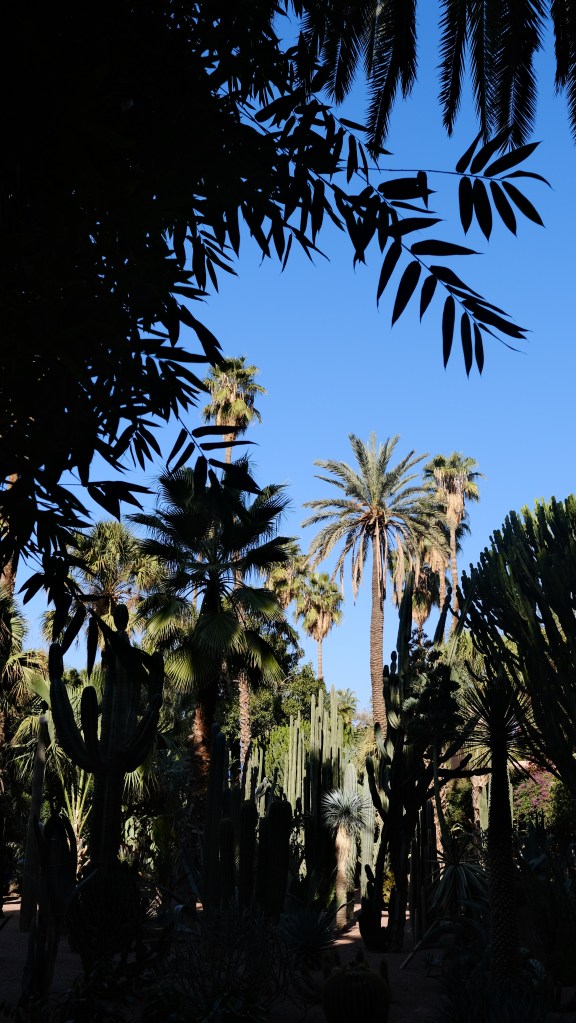
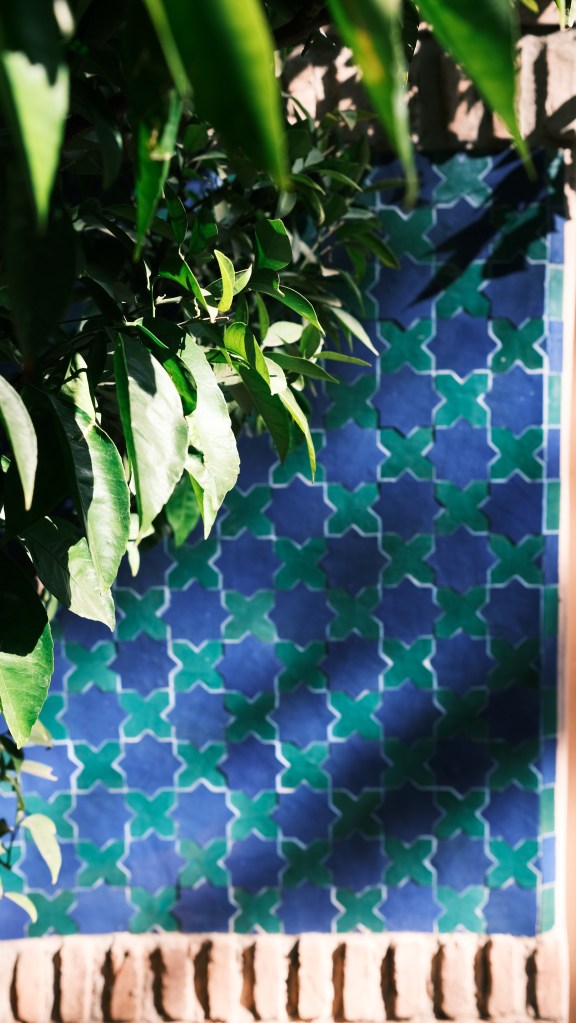
I walked through Jardin Majorelle with you. You accompanied me to that one place I had longed to see. Thank you. The walls, the cobalt blue, the trembling palms—they were breathing a love story. Pierre’s love for Yves was everywhere, threaded into the garden like veins beneath the skin. It was unpretentious and yet unyielding, a devotion that did not fade when the man was gone. It lived on in every petal, every shadow, every inch of this place, as if the garden itself had been built to keep him alive.
I stopped when I read his words, carved into memory: “I pretend to carry on with life as if nothing had happened. I’m always confronted by your absence. You were omnipresent, and you remain so.” Something inside me cracked. I realised I had never been loved in this way—so completely that absence would fill the air, so deeply that presence would still remain long after death. And in that moment, I felt it like a truth I had always carried in my marrow: I am not the kind of person who is loved like that. I am not enough for that kind of love.
The garden was not just beauty. It was testimony. In 1966, they fell in love with each other and with this city, and saved this place from ruin, and just like their love, he gave oxygen lungs to this city by safeguarding this one hectare Jardin. Pierre kept every promise without dilution, without faltering. And then I read Pierre’s words: “I have lost the witness to my life. I am afraid I shall live carelessly now.” It broke me.
That sentence was not just grief—it was consecration. It was the acknowledgement that someone had seen everything in you, had been present for all your moments, and that their absence would unravel the meaning of your days. I have never been that person for anyone. I have never been the one whose presence was a sacred anchor, whose absence would make someone fear they might live carelessly. I have never been the witness someone feared to lose. That line pressed against my oldest, most familiar wound—that no matter what I give, no matter how much I love, I will never be enough for someone to love me with that kind of constancy, that kind of unshakable devotion.
Eight months later, I understood why my hands shook in the shade of the garden walls, why my chest heaved in ache, why the tears came as if they had been waiting for years to be released. My tears weren’t only for them—they were for me. For the hollow truth that I had never been worthy such love. In that garden, I felt the full weight of what I did not have. I saw love in its most complete form, and I knew mine was smaller, more fragile, and less certain. I walked away with you that day, but in my heart I knew: I had just been a witness to a love story greater than my own. And once I had seen the real thing, I could no longer lie to myself about what I was holding. What I held in my hands was not enough. And maybe I was not enough to ever be trusted with something that great.
You snapped that picture of me tearful and taking shade along the sideways of Jardin Marjoelle. None of us knew then that sorrow was for us, even if we couldn’t yet name it.


I was unaware, completely unaware, that we had slid so close to the edge of the cliff; deceits were rife, and then there were unexplained debts. But destiny, which up to the end protected us from the worst, remained by our side- until now.
With you, I was there all the way. I followed you. I tried to help you. I accept my share of responsibility. I am aware of my mistakes. I protected you from everything—perhaps I overdid it. I often blamed myself. But it was too late. My constant refrain was always: What have I done wrong? There was no single victim, no single guilty party—or perhaps, if we are honest, there were two victims and two who were guilty.
You concealed. But I loved you, and so once again I accepted it, and even helped you in the role. I was never to block your path. Believe me, I write this with sorrow. I always felt that I was to blame, and that you were suffering terribly around me. You said so, and I believed it. You claimed those years were unbearable. The melancholy, the black bile that devoured you, would also be felt by those who approached you. Yet you maintained a front. You liked to be liked. You did everything to be the better, nicer, gentler peacemaker between us. I was the villain. You knew that in your head. You couldn’t face any other narrative. You, who had been so proud of the only thing you could win—your image in front of others—began to hate that I was deforming it. You detested me for that. Your vanity, which you so deftly played with, had taken its revenge. It’s surely what led you to destroy me over and over again every day. What you didn’t know was that the first one to suffer would be you.
You never understood me, never learned me. Even after months apart, you said, “I have been in a very reflective mode, I have been seeking counsel with people who are learned, elders. I cannot find an answer to why she will react like that.”
As the counselling took place at Darul Arqam you said, “This place brings a lot of memories to me. This place is where Megan took her Shahadah. It is a joyous moment for me.” You did not mention us. It was always about you. Not us. My conversion was for you to be pleased—not to tend to me, care for me, guide me. It was for you, for your pride, for your sense of joy. I had taken a step that would reshape my soul, and you stood there claiming it as your memory, your moment, as if my faith existed only to decorate you.
I told you why I married: “I married because I believe there is a God and I believe in this religion. There was no morals or spirituality that anchored the marriage, as much as I looked for, it was void of all that. They were not careful with me, even when I am new to this (religion), they were never Muslims. During the month of Ramadan, they ostracised me. One whole month, he had never prayed with me.“
There is a kind of death that happens long before the final breath of something. I had been grieving us in the ache of Eid mornings spent alone in prayer, to a God I pleaded to show me how to love in a place where love felt unwelcome.
“His father abused me in front of him. He never protected me. He never stood up for me.”
The mediator turned to me. “What did you do?”
“I was naive”, I said. “I thought I loved him very much. I would save the marriage”
In what might have been the last meeting of our lives, you nitpicked: “She wants breakfast, I can buy it. But don’t call it convenient. I bought her nasi lemak with fish—I remembered she likes fish. She said it was wrong. She wanted toast. Petty. This was the watershed moment for everything that followed.”
I was gutted. That was it—your threshold for the end. Then you had never known what God had given you—us. I dismantled myself methodically: trauma work, Gottman, attachment theory—every tool, every angle—to salvage something worth keeping. I kept our love on the table, bleeding but viable, hands pressed to the wound, refusing to let it die..
Nasi lemak. That was your great unraveling.
I wasn’t speaking about wrong food. I was speaking figuratively, in longing, in the last language I had left: Know me right. You never did. And the person I most needed to see me was the one who refused to look.
The Ustazah looked to me, “When you filed the case with Syariah Court, what was your intention?”
I had no answer prepared for this question, no careful words to dress the wound. The truth rose up, raw and unguarded, “To be free from pain,” I said, my voice breaking as tears burst from the weight of endurance.
Looking back, I remember almost nothing else from that session. Only those words—free from pain—hanging in the air like a confession I had been too ashamed to make until that moment. I had never said them before. Not out loud. They were the marrow-deep truth of a woman who had lived too long in a body that no longer recognised safety. Perhaps I had decided, somewhere along the way, that unsafe was the path I must walk to deserve love. If that’s true—then what have I done? What have I traded? To reach for safety, only to discover it stripped me of being worthy of his love.
She regarded me steadily, “Confirmed? Affirmative. But it still pained you?”
Her question pressed against the edges of my grief, and I could barely form the words. I stuttered through my tears, “But it will be better after that.” I clung to that, that even if I was torn apart now, there might still be a quieter, kinder life on the other side.
She watched me as if weighing my soul, and asked one last time, “Definitely this—divorce—is what you wanted?”
I replied, “Yes.” And in that single syllable, I felt the tearing away—not just from you, but from the part of myself that had believed love could survive anything if I fought hard enough. I felt myself die in that room. And I knew I would not be coming back. I wasn’t prepared to lose the version of me who would endure anything- choking, broken doors, pinning to the floor, just to be deserving.
She looked to you and asked, “What do you think after hearing her say that?”
I remember the stillness after the mediator’s words. You looked at me as if I were speaking in a language I had invented—one you had no obligation to learn. How could you not recognise the depth of my hurt? How could you sit in that room and not reach for my hand, not once, as if my grief might stain you? You could have reached for it, not to fix what was already broken, but simply to acknowledge it, to say: I see the wreckage. You did not. You let me grieve alone in full view of others, and perhaps that was the clearest sign of all: you would rather stand untarnished than stand with me. Maybe I had made it too costly, too humiliating for you to try.
You did not console me. Instead, you said, “After hearing what she said, strangely enough, I have had people come up to me and say, ‘Megan is this,’ or ‘Megan is that,’ even her mum told on her.” You sat there carefully composing each line, polishing it so that it might seem like I was opprobriated by many, so that you might stand in that room as the better person.
Better? Of course you were better. You had the composure, the restraint, the clean edges I could never hold. I was the storm, the mess, the reason we were here at all. You believed the wound was my own doing, that I had built the hurt myself and had no right to expect your hand over it.
You wanted to be the good person, even as the marriage disintegrated in the presence of another’s witnessing eyes; even as I, your wife, was almost collapsing to the floor with grief. You wanted the scene to be clean, the words to be neat, the picture of yourself to remain intact. I wanted truth. You wanted polish. I mourned the end of our marriage in raw, unguarded words. You guarded yourself from the discomfort of mine. And that was the difference between us, all along.
I remember thinking—was this what it had always been? That I had mistaken your composure for strength, when it was only performance. That I had mistaken your restraint for patience, when it was nothing more than detachment. L’amour fou. I tried leaving you, but I believed in God’s path for me towards you. I maintained it was God that kept me from leaving you. The “forever” that we shared. The “forever” that I thought I would carry to my last breath, and till I closed my eyes to Jannah. I was faithful to this “forever”, even if the price of doing so was sometimes—always—steep. I fought for the marriage in every language I knew—faith, reason. I was very afraid of being alone in this fight. Fighting alongside you, even in dysfunction, felt safer than alone. You fought too, but only for your own victory: to be right, to be admired, to remain unblemished by blame.
Deep down, you and I were always living parallel lives. Your vanity kept you from ever crossing into mine. Two lines, running side by side—close enough to imitate intimacy, but never truly touching. And yet, in some twisted way, they complemented each other. We managed to skirt the hazards of complete self-destruction. What luck.
I left that room knowing that the dialogues we had were not conversations; they were battlegrounds dressed as exchanges: Your contempt for me assaults me everywhere and forever I go, and at all moments, your detest for me was unflinching. I was never the witness you cared to lose.
“The Yves I knew, the Yves you knew, are they the same person?”
“And so, Yves, this is what I wanted to say. We have to part now, and I don’t know how to do that. – Even as I know we will never again gaze together at the sun setting behind the Agdal gardens, nor marvel side by side in front of a painting or work of art. Yes I know all that but I also know that I will never forget how indebted I am to you. In leaving you, Yves. I want to say how much I admire, respect and love you”.
 Hello Megs
Leave a comment